Friday, May 29, 2015

For my son, whose friend has moved

Tethered

You are dear to me 
in your hurt

Your wounded eyes
say plainly--
my heart is broke 

You are choked
by the strain of
getting it out

But it's still there

and no,
it's not fair

To be a child
with too loose
a hold on
his world

To be tied
to two grown-ups, 
for good and
for ill

But this pain
that's turned you
inside out--
and these tears
that seem spent
from a hole
in your chest-- 

This is the price
of loving 

you're finding


And all I can do
is love you,
in turn,
and ache

Monday, April 27, 2015

You are the everything


In the backseat of the car, their knees just touch. Like the whisper of the wheels on the ribbon of asphalt. Slight enough for intention to be the question dancing across the roof of her mouth.

The spring night is cool and damp on her skin--really too early in the year for the windows to be down, but down they are, goosebumps crimping her arms and legs, her long hair a flag she snaps with adolescent expertise. Some song is playing on the radio that she doesn't like--not yet--but may, given time. Their friends are their friends, and superfluous.

His weight grafts onto hers. She holds it, bravely. Their arms touch, without fanfare, whistling to the shimmy of the car.

So there is her answer. In this quiet collaboration of arm hair. Is it possible to be thrilled, elated and slightly sorry, all at the same time? She swallows. It is.

On the car's seat, their pinkies touch. Then more of them.

Then everything that matters, all at once.

The song changes keys, lifts. He takes her hand. She feels her hand being held, surrenders her ownership in a tight, breathless arc. His fathom of fingers swirl around her hapless digits, pause atop her boomerang pulse. In this rolling darkness, no one can see how Milky-Way bright her skin has turned. She has never been so big, or dense.

Looking out her window, she spies an airplane blinking in the sky's immense. Like an even, beating heart. On, and off. On, and off. She blinks and thinks, I'm going to die someday. Is thrilled by her ability to think such a thing, at such a moment in her life.

The song stops.

Their eyes hang on the silence.

His breath--

His breath--

Black licorice.


Thursday, April 9, 2015

Prometheus

(Photo by jasonwoodhead23)


I want to burn
blue

like a vein
contained
by its ribbon
of skin

or that lowly

Prometheus
of chemistry 
class

Taut and roaring,
steeped to 
a pique

of concert  
fury


I will show
you

what hot
is


Sunday, March 8, 2015

Lisa's Garden

Lisa Bonchek Adams


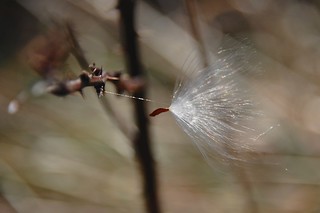
All day long, there's been a weight on my heart, because someone I never met has died.

Lisa Bonchek Adams had metastatic breast cancer. She blogged here. She tweeted here. I was one of her readers, but we never exchanged words. I wasn't a friend. She had plenty of friends already, and they hurt a lot worse than I do today. So do her husband and three children, and her parents, who have lost their beloved daughter. She was only 45. 

Lisa tweeted this message regularly, usually first thing in the morning: Find a bit of beauty in the world today. Share it. If you can't find it, create it. Some days this may be hard to do. Persevere.

She persevered. In fact, a week before she died, she shared a cache of garden photos taken over the summer. It was apparent that things were serious, but she wasn't a complainer. Nor was she a martyr. That was how she set herself apart in my mind. She hated her disease, hated it with everything she had, was not going to conceal its awfulness for a second. But she made it a point to love her life just as fiercely. She lived honestly, guided by a clarity of vision, always educating others about her setbacks and treatments, not because she relished the attention but because in sharing and educating, she found a way to control a fraction of her fate. She was famous on Twitter for her #mondaypleads, in which she begged her followers to make a healthcare appointment they'd been putting off. And people listened. Through her educating and "nagging," she likely saved countless lives. 

In her case, that's not hyperbole. Lisa didn't exaggerate. I wouldn't dare do so on her behalf. 

When I was walking the dog yesterday, I noticed the beauty of the snow. Yes, it was beautiful, in spite of my winter-sourness at this time of year. The sun was fierce, but there was still snow lining the branches of the woods by our house. The sky was a tonic of blue. Birds were darting over my head, robins were singing their little hearts out. I could feel springtime in the air, even as my feet slid out from under me. 

But the beauty hurt, because Lisa wasn't there to see it. I thought about her children, the youngest of whom is nine. I don't care what kind of preparation they had: one minute their mother was there, the next minute she was not. You can't prepare for that. Even Lisa, queen of memory boxes and advanced directives, couldn't prepare them for that. And so they're suffering today. And so, even when spring finally comes, they'll keep a sliver of winter in their hearts. Not just this year, but always.  

I was just a stranger. But I wanted Lisa to live until the spring, or summer. Even when it seemed apparent that she wasn't going to make it. I wanted her to see her garden again. I didn't want her to die in the cold.

Of course, she didn't. She died, at home, surrounded by her family. And she died having planted thousands of seeds in the hearts of those who knew her, or felt like they did. Over the years, her garden will grow, and cast seeds of its own. Who knows how far the wind will carry them? None of us can know the impact of a single life lived so fully in the sun. 

So Lisa will persevere. Her children will continue to be the heart of her garden. And through them, her life and love will flourish. 

While I'm thankful today to have been brushed by her beauty, even a little.    


---

If you'd like to donate to Lisa Bonchek Adams' metastatic breast cancer research fund at Memorial Sloan Kettering, please go here. Less than 5% of breast cancer funds go toward metastatic breast cancer research, in spite of the fact that 20-30% of breast cancer patients will eventually have a metastases. Every bit helps. 

And please, make a healthcare appointment if you've been putting one off. 


Thursday, March 5, 2015

Friday, February 13, 2015

Adult Nonfiction

(Painting by Maria Helena Vieira da Silva)

She was in a neglected corner of the university's library, her knees knocking against its most neglected shelf, pulling out books one at a time to see when they'd last been borrowed, thinking she’d become one of those people who believed, in their hearts, that books had souls--making every volume she held the more pitiable to her--when he strode down the aisle, took her by the arm and lifted her up, before kissing her hard.


She dropped her book. Dust blew off the pages like pollen. 


And as he pushed her--gently--against the stacks, and as her fingers groped at the worn, thready bindings there, trying to find a grounding, she remembered that she also had a soul. And that lips were the crack where the light fell through.  


So that she returned to him, harder, reaching her hand around his neck, and pulling him closer than that.

Letting the books be books, and only books.  


Tuesday, February 3, 2015

In Praise of Sadness


Sometimes, it seemed her sadness was a weather system, moving in and hanging around: a low-pressure throb, right under the skin.  

Sometimes, it was a night flower--the most precious, poisoned, unspoiled part of her--her very own neglected child.


And sometimes--most often--it wasn't there at all, not even a whisperful. 


But even then, in the cut-and-dry sunshine, she was capable of missing it a little. Which was its own kind of sadness, though of a sort she could still make fun of.


Because she knew that it was indulgent to see sadness that way--as some cloying root one might suck some life from, just for the sake of getting the bitters. There was little in the way of sustenance about it. 


When for so many around her, sadness was a luxury. A place to stick one's weary feet. The damp fire against the tiresome storm jawing at their scrawny shutters. Better than fear, because it was a lamentation of loss, instead of the anticipating. A hole you could slide into, a falling. Better than not caring, too, because nothing was worse than that frictionless drifting. At least with sadness, there was that bulging blackness at the bottom. That catch in one's throat to grab onto. As if you'd meant to say something in defense against it, but thought better of it, in the end. Sleep was so much easier.  


Still. She loved the word wound


She loved the smoke that curled close to its flame, before being borne away. Paper blackened at the edges. The condensate formed on two 80-proof lips, dripping dripping dripping. 


Wound was a word, then. But wasn't a word, itself, enough? 


So that if it was her own hand circling round her heart, squeezing to the point of soreness, maybe all that was just to remind herself, 


You're alive, stupid. Love it.  


Love the whole damn thing.  


Tuesday, January 27, 2015

13-34-21


She sat beside him, and he sat by her. And somehow, that was momentous. Like there was, in fact, a choosing involved. A comfort, then, beneath the nerves. 

She could speak to him today. She spoke. She thought he felt like she did, that he didn’t want to leave just yet.

The second bell sounded. They were late.

And the sun was so bright, as she rushed inside, that in that darting from brightness to not, she saw his hand gesturing as he spoke, and then, when he listened to her, pull at the back of his neck. 

So that she felt, rather than thought in words, how the universe was both very big and full of wonders, and very exact, like the numbers she spun around on her locker, and how glad she was to be a girl who knew a boy like that.  


Friday, January 23, 2015

Mary


“Let us pray,” the minister says, and the heads all bow. 

I watch them, in all their gray-haired, frail beauty. I am glad we are sitting toward the back of the funeral parlor. It has always struck me that there is something very touching, very tender-making, about the back of old people’s necks. The flesh is leaner there. I remember my granddad’s neck, the valleys worn deep between tendons, two-fingers’ width, or so I see him in my memory. Everything winnowing away with the years. As if every funeral, every loss, takes another piece from them, makes it harder to bear the weight of their heads. 

They are all beautiful. I can’t tell you how touched I am by their beauty, how it has carried them here, in their old, beaten bodies, how it has bowed their heads just now, as one. 

I am here, and separate, too. My husband takes my hand. We are separate, together. We don’t pray, though a part of me would like that comfort, to be part of the swell of tears. Well. I am part of that, anyway. I squeeze Paul’s hand. The minister speaks of another Paul. And Lazarus. And David. And too many names, really. We all want to wrap Death in stories. He is not such an alien to us then.

Her name was Mary. 

Just Mary. 

And she was my godmother. I still don’t know what that word means. What it entails, exactly. We were nothing alike, for one. But I loved her. That’s how family is supposed to work, I guess. Share a room with someone, be invited into their home often enough, and those commonplaces become a house that holds you, long beyond the shortcomings of who you are today. You can’t escape family, even when you try. That house is a burden, but it’s your burden. It’s your own scripture, kept in your back pocket, filled with names and begets and trespasses and forgivenesses. Stuffed with guilt and regret, and mystery, too. Feel the weight of it in your hands. It’s a load, an anchor. It can’t be left. The absence of it would be a ghost that sits on your chest at night, waking you from dreams. 

There is a song playing now. An awful, saccharine hymn. I cry, anyway.

Mary played the organ for her church. She played effortlessly. She must have played this song many, many times. She did everything she tried well. She was a champion of knowing what was incumbent of her. I look briefly into the minister’s face as he takes my hand in his. We smile, tightly. It is awkward, and human. We don’t know each other at all, but here we are, stuck in protocol’s receiving line. Then I am free. 

The old people file out, slowly. I assume, because Paul and I are already gone. Waiting, in the car, for the ride out to the cemetery. His hand is still in mine. 

I’d rather remember them all right there, anyway, with their heads born down, in unison, as if a load had been lifted from them. As if Grace were always that simple.